


Architecture exhibition. 16.05. - 30.06.2009. Berlin, Germany
Typical Wolfsburg
 |
 |
 |
 |
 |
DEUTSCHES ARCHITEKTUR ZENTRUM
BERLIN, GERMANY
Exhibition: Typical Wolfsburg
23 January - 8 March 2009
The arising of a new city: The DAZ presents a review on seven decades of urban development in the city
of Wolfsburg. Unlike cities that have grown naturally over time, Wolfsburg looks back on shorter stages,
which were closely connected and catalyzed by the industrial buildings of the Volkswagen factory.
Unique in Germany, the city presents innumerous post-war architectural monuments with projects
by Alvar Aalto, Hans Scharoun and Paul Baumgarten, as well as entire urban ensembles.
Today Wolfsburg is a unique and characteristic case of urban planning in Germany. The constitution
of the city, originally founded as the residential area of the "Stadt des KdF-Wagens", progressed in very
short stages. The exhibition is presented in seven chapters that relate to seven building types as seen
through the eyes of the architects, the clients as well as its residents.
Industrial buildungs. Initially the development of Wolfsburg was closely linked to the requirements
of the development of the Volkswagen factory. This is why industrial architecture in Wolfsburg is primarily
related to the VW-group: the high-rise headquarter, the workshops, the power station and the Autostadt.
Public attention has tended to concentrate on the founding years after 1938 on one hand, and new
buildings of the last decade on the other. The factory premises, covering an area almost as big
as the entire residential city of Wolfsburg, developed into a town on its own over the last 70 years.
There you find urban structures with offices, representative corporate buildings, leisure facilities
as well as gastronomic facilities, educational institutions and shops in analogy to conventional cities.
Residential. Next to the industrial facilities, residential construction became the preoccupation
for further urban development in order to fulfill the pressing need to accomodate the workers flocking
to this hitherto untouched area. Building activity concentrated on housing for nearly 20 years.
15.000 people lived in the young city at the end of the World War Two, ten years later Wolfsburg had
50,000 residents withlots of them in temporary accomodation. In 1957, the year when the new Hansaviertel
was completed in Berlin for the International Building Fair „Interbau“, the new district Detmerode was
set up in Wolfsburg. It encapsulates the very rational approach of housing and urban planning of the early
nineteen sixties.
Retail and commercial. The second step in the years following 1950, was to create a suitable
environment for people in terms of facilities for shopping, education and their religious needs within
a decentralized framework, where each district obtained its own small retail center. The first German
shopping mall designed by Paul Baumgarten was opened in 1961 in this context. At the same time
the urban environment for central Wolfsburg was developed. In 1950 first buildings arose along
Porsche Straße, which forms a central axis between Klieversberg and the palace. It was transformed
into a pedestrian area between 1977 and 1980, in line with a general trend in contemporary Germany
at the time.
Educational. Schools and kindergartens for the exceptionally young population needed to be
built in quick succession. Two of the most striking projects are the Heilig-Geist creche by Alvar Aalto
and the Stephanus creche by Hans Scharoun, completed at the end of the 1960s. Both architects took
the particular needs of children into consideration for their designs.
Religious. Until the mid nineteen 70s, more than 24 churches – Protestant as well as Catholic–
had been built in the former National Socialist model city, which had not provided church buildings
for obvious political reasons. Hence Wolfsburg now has an extraordinary range of post-war church
buildings in Germany. Some highlights are the Heilig Geist and St Stephanus churches by Finnish
architect Alvar Aalto.
Cultural. A new era of developement was entered after 1965 with the erection of large scale
cultural buildings, which have become definitve landmarks in Wolfsburg`s city centre. Their inceptin
was due to the overall aim not to create merely a labourers’ settlement but an entirely „real“ city.
The Arts Centre again designed by Alvar Aalto opened in 1962 and became as exemplary as Hans
Scharoun’s new theatre completed in 1973. The new VW theme park Autostadt completed in 2000
became the extension of the central axis through the city. And the residential city center was at long last
connected with the manufacturing area via a new bridge across the Mittellandkanal. The new science
exhibition center phæno, designed by London-based architect Zaha Hadid, has formed the urban
counterpart to the Autostadt and another highlight of Wolfsburg`s cultural buildings.
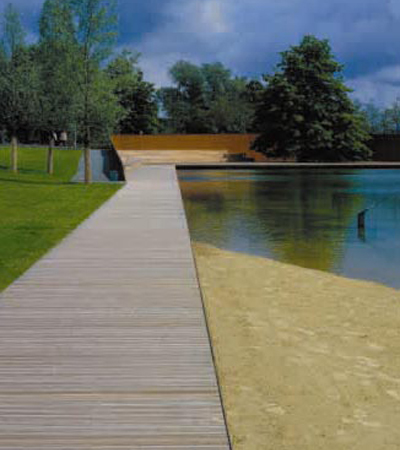
Landscaping. This has become the focus of urban development in Wofsburg over the last ten
years. The aim is to set up spatial unity between the various residential areas and to enhance Wolfsburg’s
potential as a tourist attraction and green city. The ample green spaces in the Autostadt, the themed
park Mobilität und Bewegung inaugurated for the Landesgartenschau 2004, and the Sommerland, opened
in 2006, have contributed to Wolfsburg`s new identity as a city of leisure and experience.
The exhibition presents the various layers of 70 years of city development in Wolfsburg. They are still visible
in the city today, as most buildings and the urban environment remain unspoilt and in their original state.
Modern architecture has shaped the face of Wolfsburg and the city today embodies the characteristics
of 20th and 21st century architecture. „Typical Wolfsburg!“ offers new perspectives on modern every-day
architecture like the local church, the school or the kindergarten– in Wolfsburg as well as in your own
neighbourhood.
CREDITS:
Text: DAZ - Deutsches Architektur Zentrum
Photography:
01
Autostadt Wolfsburg
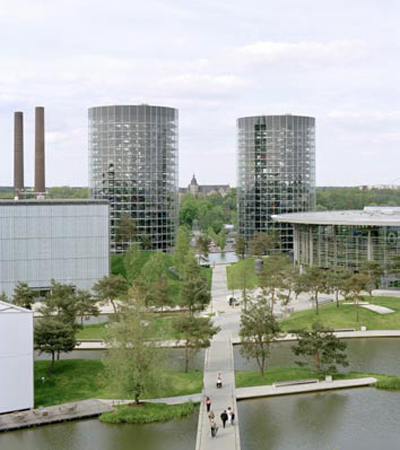
Theme of „70 years Wolfsburg“ In the two towers, made from steel and glass, almost 800 new cars are
stored for the customers. Design: 1996, completion: 2000 Architect: Prof. Dr. Gunter Henn,
Henn Architekten, München
Photo: Klemens Ortmeyer, Braunschweig, 2005
02
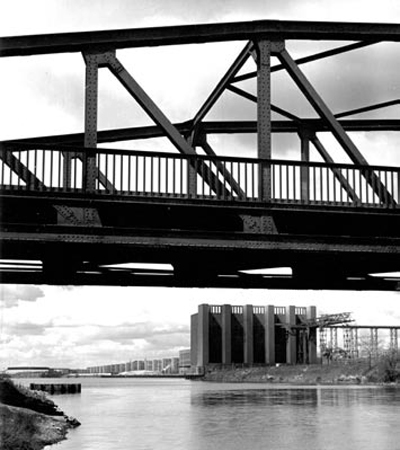
Chapter 1 „Industrial buildings“
View on the main facade of the Volkswagen factory at the Mittellandkanal. Architects: Emil Rudolf Mewes,
Fritz Schupp & Martin Kremmer, Karl Kohlbecker (collaboration) Competition: 1937, Realization: 1938-40
Photo: Stadtarchiv Wolfsburg
10
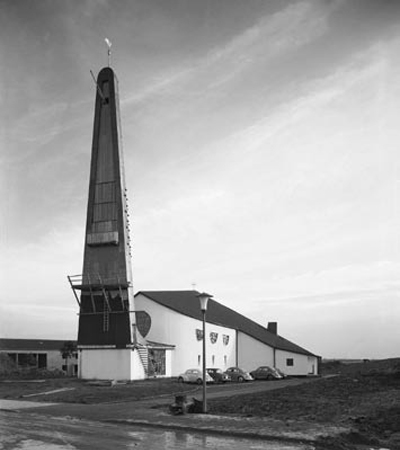
Chapter 5 „Church buildings“
The building site of the Paulus Church in Wolfsburg, 1964. Architects: Gerhard and Dieter Langmaack
Realization: 1958-60
Photo: Stadtarchiv Wolfsburg
12
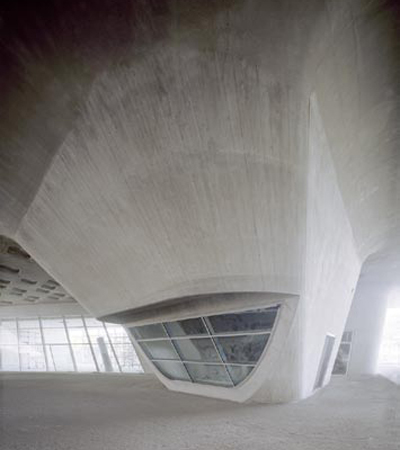
Chapter 6 „Cultural buildings“
„phæno“. World of experiments and spectacular sculptured building. Architect: Zaha Hadid, London.
Competition: 2000, Realization: 2001-2005
Photo: Klemens Ortmeyer (Copyright: Stadt Wolfsburg)
15
Chapter 7 „Landscaping“
Park „Mobilität und Bewegung“, Landesgartenschau 2004. Landscape architect: Gabriele G. Kiefer, Berlin
Competition: 2002, Realization: 2003-2004
Photo: Hanns Joosten, (Copyright Büro Kiefer)
Copyright 2007 - 2009 architeria.eu all rights reserved

