


Architecture exhibition. 16.05. - 30.06.2009. Berlin, Germany
17 SOCIAL HOUSING
 |
 |
 |
 |
 |
 |
Photography: Benoît FOUGEIROL
ARCHITECTURE AS BONUS
Paul Ardenne
The construction of the housing project at 45 rue Louis Blanc in the 10th Arrondissement of Paris is the result
of a project launched in 1998 by the Paris city real-estate authority (Régie Immobilière de la Ville de Paris –
RIVP). The property developer was expected to take a piece of land measuring about 600 m² and replace
an abandoned squat there which had been slotted for demolition with a low-cost building that adhered to
the HQE (High Environmental Quality) standards still being determined at the time. The building that
architects Dominique Marrec and Emmanuel Combarel completed in early 2007 meets this challenge with
both efficiency and elegance. Classified as “Habitat and Environment” (an environmental certification),
it immediately became a talked-about icon in the urban landscape – the very sign of an architecture that
is both engaged and sensitive – as well as a dwelling of reputable comfort.
ECDM, sophisticated efficiency
Emmanuel Combarel and Dominique Marrec are the founders of the ECDM agency, created in 1993 and
based in Paris on Passage Turquetil. ECDM’s buildings, which are noted for their attention to context
and consistently sober style, are a blend of practical and aesthetic clarity and coherence. “If a dominant
characteristic could be singled out in the agency’s work,” according to Marrec and Combarel themselves,
“it’s the determination to propose a simple architecture within a strict logic without any preconceived
notions, nostalgia or stylistic concern.”
Same yet not the same
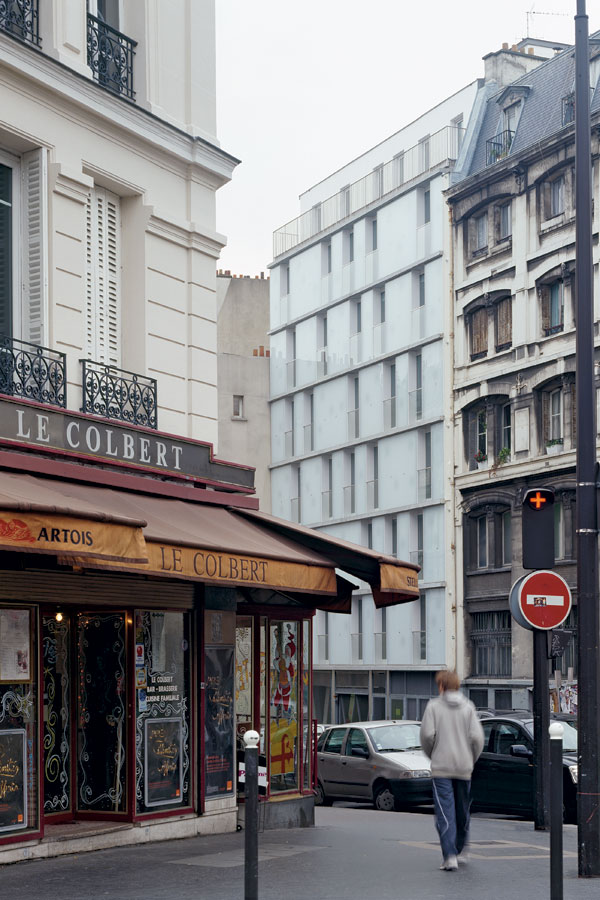
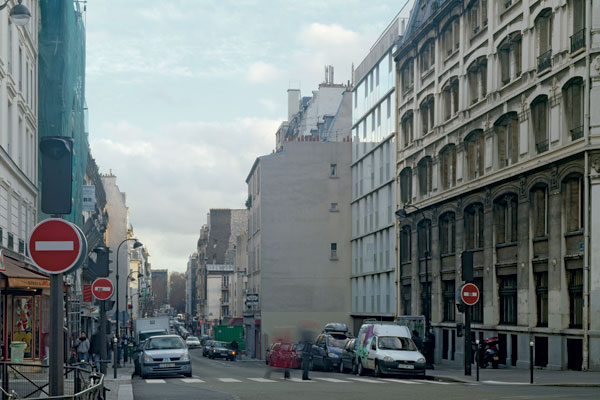
The building at 45 rue Louis Blanc has the effect of a jewel of gracefulness set in a conventional, heavy
architectural environment: a building of non-aggressive, ethereal appearance with an uncommon strength
of presence implanted in a nondescript street. An oddity, one might say, yet endowed with incontestable
mimetic qualities. Its height? It respects the neighbouring skylines. The floors of the building? Stories stacked
at regular intervals, in a conventional manner, in visual conformity with the surrounding standards.
Its position? Aligned with the street, without spilling out or reshaping the lines of perspective.
For the passer-by looking at it from the sidewalk and comparing it to the letter with the Haussmann style
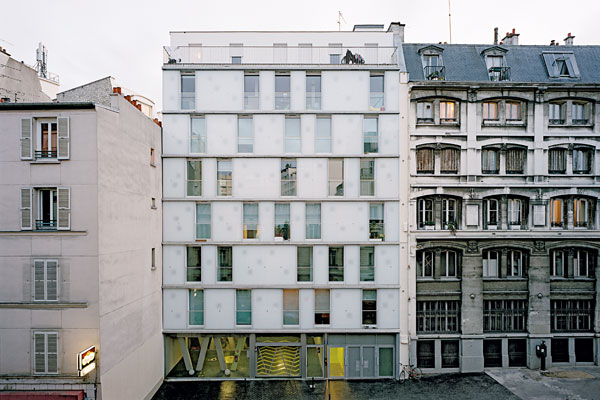
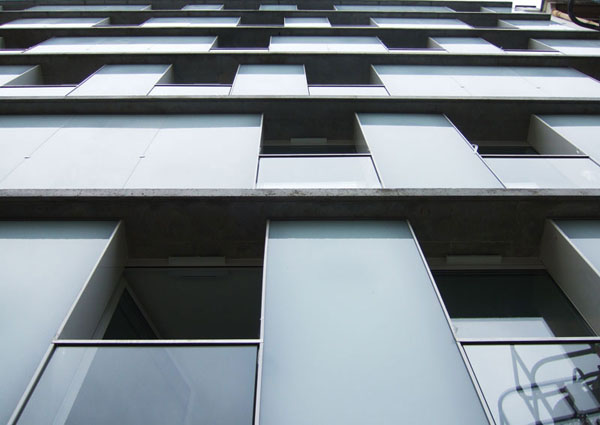
structure (a ground floor + 7 stories), 45 rue Louis Blanc immediately stands out in two ways. First, by
its façade with its scattered placement of windows and square oculi, covered with opalite panels.
This glassy, whitish “over-façade” – with an opacity which makes it look frosted – is very soft, and
contrasts nicely with the surrounding mineral atmosphere. Though highly “visible”, it is also discreet.
In no way ostentatious or flashy, it also plays the role of a diffuser of light come nightfall. Its surface
is enhanced by the light emanating from apartments inside, as well as a carefully designed, soft and serene
lighting system which has a reassuring effect.
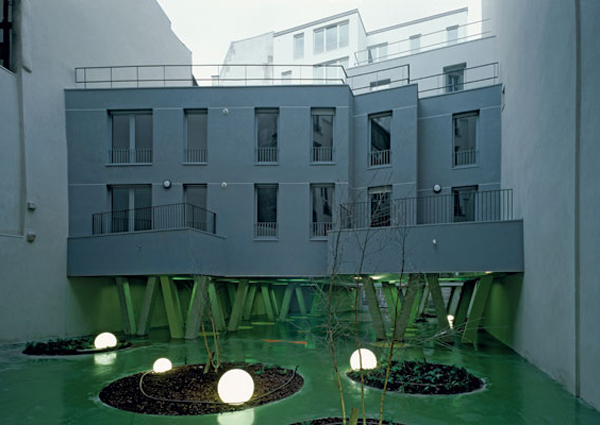
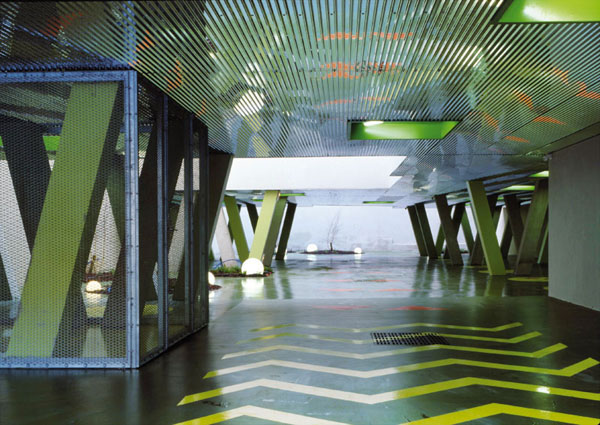
The second unique feature of 45 rue Louis Blanc is its parking lot, which is located at street level and not,
as is the Paris tradition, deep underground. Directly accessible from the street and sidewalk and separated
from the outside by mesh fencing, the parking lot is located on the ground floor, a vacant area punctuated
by the hypostyle pattern of the cement columns supporting the building, slanted to give the effect of
fingers holding up the first level. Besides room for cars, the parking lot also provides storage space: there’s
a mesh cage where bikes and strollers may be kept. We notice that the parking lot of 45 rue Louis Blanc,
a functional area rather than a dead-end, transforms into a garden that encloses the perspective.
The space is both operational and pervasive, and its location on the ground level invalidates the conventional
entrance which often becomes the dramatized “sign” of apartment building facades. Here, the entrances
are in fact relegated off to the side of the façade and in the back of the building, where they are discreet
and don’t take up any extra space.
Last but not least, positioning the parking lot on the ground floor avoids the aversion often felt towards
street-level apartments, which are often criticized and subject to the many annoyances we know: poor
visibility, lack of natural light, street noise (which here has been ranked 35 db, so rather loud), and finally,
due to its proximity to the exterior, an easy target for breaking and entering.
Integrate and make things pleasant
This double characterization of the form is, in itself, enough to make Marrec and Combarel’s building stand
out, as no other structure in the immediate surroundings allows itself to play this way with the local “style”.
Yet we also remark many additional elements that make 45 rue Louis Blanc noteworthy, this time implicitly
in keeping with the HQE standards: to fit the site and its natural and anthropical conditions as well as
possible. The size of building defends the idea of integration: nothing is out of line, and the dimensions
and volume of the exterior morphologically “toe the line”. Its appearance has been thoroughly thought out.
The north façade – with its windows and “opalite” insulation panels, which faces the street and emphasizes
verticality – is counterbalanced by the rear of the building that faces the courtyard and has southern
exposure, and has been designed differently – with successively receding stories. From the seven stories
in the front, we taper down to two in the back, a reduction in the number of floors which allows a fair
and equal distribution of daylight among the 17 apartments in the building that range from 50 to 114 m²
in surface area. The graded layout of the back of the building has another advantage: there are private
terraces and balconies for several apartments, conveniences and other features that the traditional
“tenement” can’t offer. A housing structure, yes, but diversity in the housing conditions.
Another one of the “HQE” criteria found at 45 rue Louis Blanc comes from the principle of pleasance that
its designers were attached to creating, though not without resistance (the project required no fewer
than seven consecutive building permits). In this regard, establishing a garden at the back of the courtyard,
given the surrounding congestion and the complexity of the floor plan, was no easy task. A garden to look
at, but also to use, “to be experienced”, whose genuine lack of space and rather unwelcoming surroundings
(the piece of land is enclosed by high common walls) make it neither off-putting nor excessively cramped.
The fact that the garden is conceived to be a natural extension of the parking lot increases its usable
surface area, in fact, notably for the building’s children who use it as one continuous play space. All this
in the vein of “pleasance”, a word also fitting the color scheme – surely not anecdotal – that Marrec
and Combarel devised, alternating various lukewarm or “cool” colors (especially green) with areas that
leave the raw concrete exposed. Or else finely detailed decorative elements that tend to make the
building more charming: discreet steel inserts in the facade, or the corrugated stainless steel ceiling of the
parking lot that reflects and shines, capturing the light around.
Unbiased
We know to what extent housing projects, for a good many neomodern architects, could only consist of a
miniaturization of bourgeois housing structures: a specific type of housing with a working class twist or
targeting “the masses”, as it was still said in the 1970s. These apriorisms – as sociological as they are
political – resulted in the “form” itself of the traditional housing project (or rather its absence of form),
a fundamentally tiresome “form” showing little invention and above all a lack of generosity. Another brand
of social punishment.
Marrec and Combarel, as we’ve seen, don’t subscribe to these outmoded presuppositions in the least.
They belong to the generation of architects trained in the 80s for whom the housing project is more of an
inevitability than a creed, and even less an insidious vector of a politicized architecture serving to relay
a societal vision hooked on the proletarianized reality. Though not devoid of interest in the social question –
and the closely related issue of a partial solution to it via architecture – their approach is nonetheless
simpler, in any case, never declarative. In short, it’s an approach that is free of complexes, that is contextual
and potential. An approach free of complexes: a housing structure, for Marrec and Combarel, is above all
a dwelling where the idea is to feel as good as possible, where one feels at ease – at home, as we say.
Everything is conceived with this in mind, from the very beginning when the notion of design itself is turned
on its head. For example, we notice that 45 rue Louis Blanc is distinguished by the absolute heterogeneity
of the floor plans for its different apartments, none of which share the same layout. Because, simply
speaking, this is the positioning that was required for the light (most of the apartments in fact have windows
on more than one side).
Contextual approach? The programmatic vision, which shouldn’t necessarily be banned, must nevertheless
hand be tempered by a specific examination of the conditions of implantation and the expectations in terms
of local reception, which are necessarily specific. No building can, in fact, look like any other. The difference
is not firstly a question of style (asserting an otherness, standing out, being conspicuous, etc.) but the
consequence of adaptation, the essence of innovative architecture so dear to Marrec and Combarel.
This emphasis on adaptation is the reason the parking lot at 45 rue Louis Blanc only contains thirteen places
for the seventeen apartments, despite the rule that says each apartment in a housing project should have
a corresponding parking space. In reality, however, the parking lots in this kind of dwelling are under-used
for economic reasons (not all the residents have cars), and the free space is in fact unnecessarily lost.
An anomaly which usually comes to light once the building’s in use but which, this time, has been avoided.
As for the so-called “potential” approach – which indicates the modus operandi of Marrec and Combarel –
what is to be understood by that? The relentless drive of these two architects to “push” the concept to
the maximum number of possible factual, technical and aesthetic openings it seeks. The structural efficiency,
if need be, requires the perfection of particular techniques: for example, at 45 rue Louis Blanc, the building’s
supporting columns positioned in the form of a W, which cancels out the lateral pressure and makes
the building completely self-standing, despite the adjoining edifices. The search for visual unity also requires
one façade to be completely painted over, a rather uncommon choice. Yet that’s the option which was
chosen for this building where each wall – as well as the uprights of its window frames and their railings –
is painted.
A manifesto to popularize
An unusual construction, 45 rue Louis Blanc nevertheless possesses all the features of an ordinary
operation: there’s nothing more to be said about the options chosen – layout, comfort, visual aspect – so
well do they harmonize with the “welcoming aspect” expected from a main home, be it a housing structure
for low-income tenants. If this building has the effect of a “manifesto”, it’s not in the sense of a restricted
singularity, but in its successful adaptation.
All in all, once the building is finished, it’s the occasion to verify if it’s still possible to provide more,
by confirming a ‘bonus’ architecture. In other words? A means of conceiving buildings not first as material
objects but as a mine of applied conceptual possibilities and accessible practices. On the condition, of course,
that there is intentional and unconventional reflection.
Project data:
> Program: 17 social housing
> Client: RIVP Régie Immobilière de la Ville de Paris
> Architects: ECDM architectes
> Project manager: Dario OESCHLI
> Engineering: BETIBA
> General contractor: Les Maçons Parisiens
> Location: 45 rue Louis Blanc, Paris X, France
> Site Area: 550 m²
> Floor area: 1537 m² (including halls, circulations…), 1 266 m² (apartments only)
> Building scale: 7 stories on the street down progressively to 2 stories, elevated on pilotis above a garden
generalized to the whole site where cars can be parked
> Cost: 2 190 000 € HT
> Finished: 2006, November
ARCHITECTURE AS BONUS
Paul Ardenne
The construction of the housing project at 45 rue Louis Blanc in the 10th Arrondissement of Paris is the result
of a project launched in 1998 by the Paris city real-estate authority (Régie Immobilière de la Ville de Paris –
RIVP). The property developer was expected to take a piece of land measuring about 600 m² and replace
an abandoned squat there which had been slotted for demolition with a low-cost building that adhered to
the HQE (High Environmental Quality) standards still being determined at the time. The building that
architects Dominique Marrec and Emmanuel Combarel completed in early 2007 meets this challenge with
both efficiency and elegance. Classified as “Habitat and Environment” (an environmental certification),
it immediately became a talked-about icon in the urban landscape – the very sign of an architecture that
is both engaged and sensitive – as well as a dwelling of reputable comfort.
ECDM, sophisticated efficiency
Emmanuel Combarel and Dominique Marrec are the founders of the ECDM agency, created in 1993 and
based in Paris on Passage Turquetil. ECDM’s buildings, which are noted for their attention to context
and consistently sober style, are a blend of practical and aesthetic clarity and coherence. “If a dominant
characteristic could be singled out in the agency’s work,” according to Marrec and Combarel themselves,
“it’s the determination to propose a simple architecture within a strict logic without any preconceived
notions, nostalgia or stylistic concern.”
Same yet not the same
The building at 45 rue Louis Blanc has the effect of a jewel of gracefulness set in a conventional, heavy
architectural environment: a building of non-aggressive, ethereal appearance with an uncommon strength
of presence implanted in a nondescript street. An oddity, one might say, yet endowed with incontestable
mimetic qualities. Its height? It respects the neighbouring skylines. The floors of the building? Stories stacked
at regular intervals, in a conventional manner, in visual conformity with the surrounding standards.
Its position? Aligned with the street, without spilling out or reshaping the lines of perspective.
For the passer-by looking at it from the sidewalk and comparing it to the letter with the Haussmann style
structure (a ground floor + 7 stories), 45 rue Louis Blanc immediately stands out in two ways. First, by
its façade with its scattered placement of windows and square oculi, covered with opalite panels.
This glassy, whitish “over-façade” – with an opacity which makes it look frosted – is very soft, and
contrasts nicely with the surrounding mineral atmosphere. Though highly “visible”, it is also discreet.
In no way ostentatious or flashy, it also plays the role of a diffuser of light come nightfall. Its surface
is enhanced by the light emanating from apartments inside, as well as a carefully designed, soft and serene
lighting system which has a reassuring effect.
The second unique feature of 45 rue Louis Blanc is its parking lot, which is located at street level and not,
as is the Paris tradition, deep underground. Directly accessible from the street and sidewalk and separated
from the outside by mesh fencing, the parking lot is located on the ground floor, a vacant area punctuated
by the hypostyle pattern of the cement columns supporting the building, slanted to give the effect of
fingers holding up the first level. Besides room for cars, the parking lot also provides storage space: there’s
a mesh cage where bikes and strollers may be kept. We notice that the parking lot of 45 rue Louis Blanc,
a functional area rather than a dead-end, transforms into a garden that encloses the perspective.
The space is both operational and pervasive, and its location on the ground level invalidates the conventional
entrance which often becomes the dramatized “sign” of apartment building facades. Here, the entrances
are in fact relegated off to the side of the façade and in the back of the building, where they are discreet
and don’t take up any extra space.
Last but not least, positioning the parking lot on the ground floor avoids the aversion often felt towards
street-level apartments, which are often criticized and subject to the many annoyances we know: poor
visibility, lack of natural light, street noise (which here has been ranked 35 db, so rather loud), and finally,
due to its proximity to the exterior, an easy target for breaking and entering.
Integrate and make things pleasant
This double characterization of the form is, in itself, enough to make Marrec and Combarel’s building stand
out, as no other structure in the immediate surroundings allows itself to play this way with the local “style”.
Yet we also remark many additional elements that make 45 rue Louis Blanc noteworthy, this time implicitly
in keeping with the HQE standards: to fit the site and its natural and anthropical conditions as well as
possible. The size of building defends the idea of integration: nothing is out of line, and the dimensions
and volume of the exterior morphologically “toe the line”. Its appearance has been thoroughly thought out.
The north façade – with its windows and “opalite” insulation panels, which faces the street and emphasizes
verticality – is counterbalanced by the rear of the building that faces the courtyard and has southern
exposure, and has been designed differently – with successively receding stories. From the seven stories
in the front, we taper down to two in the back, a reduction in the number of floors which allows a fair
and equal distribution of daylight among the 17 apartments in the building that range from 50 to 114 m²
in surface area. The graded layout of the back of the building has another advantage: there are private
terraces and balconies for several apartments, conveniences and other features that the traditional
“tenement” can’t offer. A housing structure, yes, but diversity in the housing conditions.
Another one of the “HQE” criteria found at 45 rue Louis Blanc comes from the principle of pleasance that
its designers were attached to creating, though not without resistance (the project required no fewer
than seven consecutive building permits). In this regard, establishing a garden at the back of the courtyard,
given the surrounding congestion and the complexity of the floor plan, was no easy task. A garden to look
at, but also to use, “to be experienced”, whose genuine lack of space and rather unwelcoming surroundings
(the piece of land is enclosed by high common walls) make it neither off-putting nor excessively cramped.
The fact that the garden is conceived to be a natural extension of the parking lot increases its usable
surface area, in fact, notably for the building’s children who use it as one continuous play space. All this
in the vein of “pleasance”, a word also fitting the color scheme – surely not anecdotal – that Marrec
and Combarel devised, alternating various lukewarm or “cool” colors (especially green) with areas that
leave the raw concrete exposed. Or else finely detailed decorative elements that tend to make the
building more charming: discreet steel inserts in the facade, or the corrugated stainless steel ceiling of the
parking lot that reflects and shines, capturing the light around.
Unbiased
We know to what extent housing projects, for a good many neomodern architects, could only consist of a
miniaturization of bourgeois housing structures: a specific type of housing with a working class twist or
targeting “the masses”, as it was still said in the 1970s. These apriorisms – as sociological as they are
political – resulted in the “form” itself of the traditional housing project (or rather its absence of form),
a fundamentally tiresome “form” showing little invention and above all a lack of generosity. Another brand
of social punishment.
Marrec and Combarel, as we’ve seen, don’t subscribe to these outmoded presuppositions in the least.
They belong to the generation of architects trained in the 80s for whom the housing project is more of an
inevitability than a creed, and even less an insidious vector of a politicized architecture serving to relay
a societal vision hooked on the proletarianized reality. Though not devoid of interest in the social question –
and the closely related issue of a partial solution to it via architecture – their approach is nonetheless
simpler, in any case, never declarative. In short, it’s an approach that is free of complexes, that is contextual
and potential. An approach free of complexes: a housing structure, for Marrec and Combarel, is above all
a dwelling where the idea is to feel as good as possible, where one feels at ease – at home, as we say.
Everything is conceived with this in mind, from the very beginning when the notion of design itself is turned
on its head. For example, we notice that 45 rue Louis Blanc is distinguished by the absolute heterogeneity
of the floor plans for its different apartments, none of which share the same layout. Because, simply
speaking, this is the positioning that was required for the light (most of the apartments in fact have windows
on more than one side).
Contextual approach? The programmatic vision, which shouldn’t necessarily be banned, must nevertheless
hand be tempered by a specific examination of the conditions of implantation and the expectations in terms
of local reception, which are necessarily specific. No building can, in fact, look like any other. The difference
is not firstly a question of style (asserting an otherness, standing out, being conspicuous, etc.) but the
consequence of adaptation, the essence of innovative architecture so dear to Marrec and Combarel.
This emphasis on adaptation is the reason the parking lot at 45 rue Louis Blanc only contains thirteen places
for the seventeen apartments, despite the rule that says each apartment in a housing project should have
a corresponding parking space. In reality, however, the parking lots in this kind of dwelling are under-used
for economic reasons (not all the residents have cars), and the free space is in fact unnecessarily lost.
An anomaly which usually comes to light once the building’s in use but which, this time, has been avoided.
As for the so-called “potential” approach – which indicates the modus operandi of Marrec and Combarel –
what is to be understood by that? The relentless drive of these two architects to “push” the concept to
the maximum number of possible factual, technical and aesthetic openings it seeks. The structural efficiency,
if need be, requires the perfection of particular techniques: for example, at 45 rue Louis Blanc, the building’s
supporting columns positioned in the form of a W, which cancels out the lateral pressure and makes
the building completely self-standing, despite the adjoining edifices. The search for visual unity also requires
one façade to be completely painted over, a rather uncommon choice. Yet that’s the option which was
chosen for this building where each wall – as well as the uprights of its window frames and their railings –
is painted.
A manifesto to popularize
An unusual construction, 45 rue Louis Blanc nevertheless possesses all the features of an ordinary
operation: there’s nothing more to be said about the options chosen – layout, comfort, visual aspect – so
well do they harmonize with the “welcoming aspect” expected from a main home, be it a housing structure
for low-income tenants. If this building has the effect of a “manifesto”, it’s not in the sense of a restricted
singularity, but in its successful adaptation.
All in all, once the building is finished, it’s the occasion to verify if it’s still possible to provide more,
by confirming a ‘bonus’ architecture. In other words? A means of conceiving buildings not first as material
objects but as a mine of applied conceptual possibilities and accessible practices. On the condition, of course,
that there is intentional and unconventional reflection.
Project data:
> Program: 17 social housing
> Client: RIVP Régie Immobilière de la Ville de Paris
> Architects: ECDM architectes
> Project manager: Dario OESCHLI
> Engineering: BETIBA
> General contractor: Les Maçons Parisiens
> Location: 45 rue Louis Blanc, Paris X, France
> Site Area: 550 m²
> Floor area: 1537 m² (including halls, circulations…), 1 266 m² (apartments only)
> Building scale: 7 stories on the street down progressively to 2 stories, elevated on pilotis above a garden
generalized to the whole site where cars can be parked
> Cost: 2 190 000 € HT
> Finished: 2006, November
Copyright 2007 - 2009 architeria.eu all rights reserved

