


Architecture exhibition. 16.05. - 30.06.2009. Berlin, Germany
PARKRAND BUILDING
 |
 |
 |
PARKRAND BUILDING
Photography: Rob 't Hart photography
Buurt 9 (neighborhood number nine) is a characteristic piece of the Amsterdam Western Garden Cities,
a big housing development of the 1950s and 1960s built with the aim to house as many people as quickly
as possible. But the design of the Garden Cities has enormous spatial qualities: sequences of spacious
parks surround the neighborhoods and give the development its name.
Recently the area needed to be upgraded. The smaller houses have to be replaced by bigger apartments
and villas in order to attract middle class residents. The technical standards of the buildings have to be
improved to meet new requirements. Many lawns are filled-up contradicting one of the best qualities of the
Cities: the spacious lawns and parks.
How can the Buurt 9 renovation comment on this development? How can it densify while adding to the parks?
Can it create an icon out of this operation?
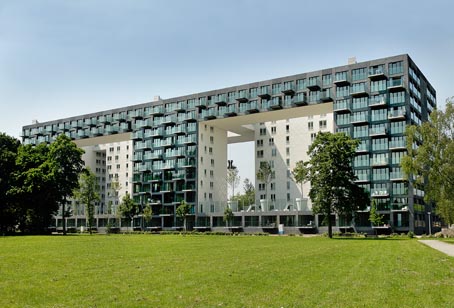
Buurt 9 consists of 174 standard small housing units that are located in three L-shaped buildings positioned
next to a small park.
By replacing them in a compact but impressive volume, the park can be enlarged. It leads to an impressive
volume that obtains attention, for itself but maybe (and that is more important) for the new neigborhood.
The proportions of the outline for the block, 135 m long by 34 m high and 34 m deep, could be considered
as mansion-like in relation to the even more spacious park. A new “landhouse” arises that produces more
character for the park.
By splitting the program into five towers that are sandwiched between a deck with the amenities and roof of
penthouses, an open and airy block is formed, offering variations of views from all directions. It creates a lifted
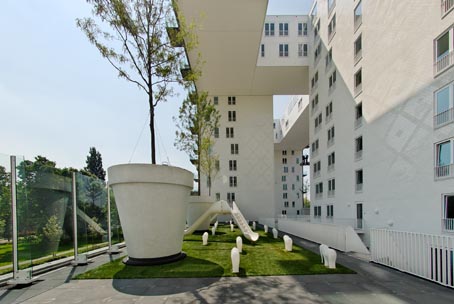
semi-public park, a semi-public balcony that overlooks the park. This garden can be seen as a supplement to
the park and ‘enlarges’ it, even when it is built...
The garden offers better protection to rain and wind, secured access, and more intimate spaces and
playgrounds. It will be used more frequently and by different people than the park. This space becomes
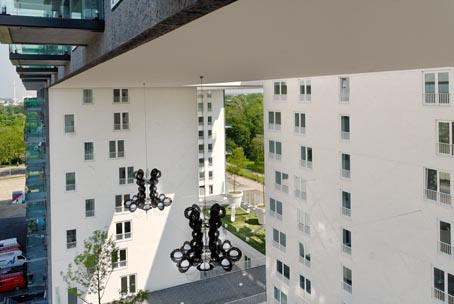
the central space for the inhabitants, the “living room,” that’s been stressed by soft furniture, decorative
walls, ceiling and floor finishes, plants, and “chandeliers.”
The towers are positioned in such a way that on the one hand they do not block views from the neighborhood
to the park and on the other all apartments located in the towers combine a view to the park with good sun
orientation. This is achieved by perforating the roof plate with three holes. In the bottom plate this principle is
repeated, so by making two courtyards that give light, view and access to the apartments on the first level.
In that way the new Buurt Ne9en park building is adding more “garden” and more “city” to the changing
Western Garden Cities of Amsterdam. It is continuing the optimistic tradition that characterizes the history of
these neighborhoods.
Copyright 2007 - 2009 architeria.eu all rights reserved

