


Architecture exhibition. 16.05. - 30.06.2009. Berlin, Germany
Media Facade Festival
 |
 |
 |
MEDIA FACADE FESTIVAL
EXHIBITION: 16.10 - 12.12.2008, DAZ_Scharoun Saal
DAZ Köpenicker Str. 48/49 10179 Berlin
Tue to Fri 12am – 7pm, Sat + Sun 2pm – 7pm. Free entrance
The interface between virtual and real urban space: DAZ are proud to present a number of media
façade projects as part of Berlin’s Media Façade Festival. The presentation will provide technical
background information on how these projects were achieved and feature seminal new developments
in media communication in public space.
Modern communication technologies are transforming social networks. Social contacts and identities
are increasingly being determined by virtual spaces. More attention will therefore have to be paid on
linking up this new virtual public with real city spaces, if we want to maintain their social relevance
and urbanity. Media architectures could counteract the growing sense of displacement in public space,
as long as their content is not solely determined by commercial interests, but acknowledges civil
socio-cultural concerns as well.
Media façades provide new opportunities for communication in public space. Buildings whose surface,
and hence character, changes continuously will generate new relations between a city’s residents
and their surroundings and incite interactive participation. Structure and façade present new challenges
to architects, art professionals, and technical services engineers. Setting up a media façade not only
requires specialised technological and financial knowledge, but also an open- minded approach to a new
design task.
Exhibition
This is the exhibition to accompany the Berlin Media Façade Festival. Curated by media and interaction
designer Gernot Tscherteu of the Media Architecture Group, Vienna, it focuses on the relation between
digital images and building shell. As manager of research consortium mediafacade.net, Gernot Tscherteu
has been involved in developing high calibre, integrated system solutions for media facades. He holds
a PhD in political studies and became project coordinator for the „Leuchtathletik“ LED project at the Vienna
University of Applied Arts and co-organizer of the London Media Architecture Conference in 2007,
after having collaborated in a number of media projects for the Austrian Academy of Sciences, the ZKM
Karlsruhe, and Museumsquartier Vienna. At the DAZ Gernot Tscherteu will demonstrate the evolution
of new hybrid forms of what is now termed media architecture through the fusion of architectural
structure and digital display. The exhibition will focus on a variety of architectural and artistic strategies
when dealing with media facades, and compare a number of current projects and innovative approaches.
It will explore technological myth as well as practical aspects of creating media facades, such as LED
technology, detail solutions, screening and financing options and energy consumption issues.
The introductory section will explore the technical background of media facades, such as façade types,
content formats and display properties. This will lead over into the exhibition’s main section with a display
of sixteen current international projects on double sided illuminated display cases, ranging from office
buildings such as the Dexia Office Tower in Brussels, the KPN Tower in Rotterdam and the Vienna
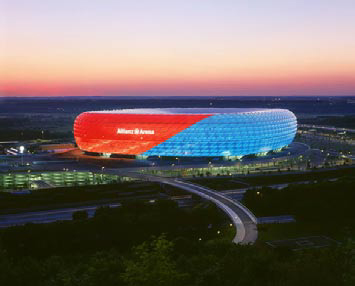
Uniqa Tower to sports arenas such as Munich’s Allianz Arena by Herzog & de Meuron, arts complexes,
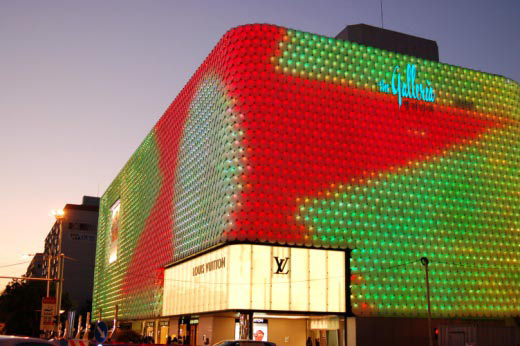
and commercial developments such as the conversion of the Galleria Store in Seoul designed
by UN Studio.
This Dutch architects, in collaboration with Arup Lighting, have designed a chameleon-like building
with a façade entirely covered in 4.500 slab shaped LED lamps that operate as pixels merging into an
overall picture. Light reflexive during daytime, the lamps are computer operated and will erupt into
ever-changing backlit colour at night. At the DAZ the project can be experienced on a 4,4 x 2,5 metre
façade model specially devised by Arup for this exhibition.
This will be confronted with other artist-designed projects that are less concerned with a particular building
form and function. One key project has been the temporary Blinkenlights experiment on “Haus des Lehrers“
at Berlin’s Alexanderplatz in 2003. Devised by the “Chaos Computer Club“ it generated interactive
messages from the general public using the illuminated windows of the strict façade grid, each forming
an oversized pixel of a facade-covering image.
The GreenPix zero energy project in Beijing combines art with a high tech approach, developed by New
York architects Simone Giostra & Partners in collaboration with Arup engineers. With an expanse covering
2,200 sq metres, the suspended curtain façade of the Xicui entertainment complex, inaugurated in 2008,
constitutes the largest LED colour display worldwide. The façade can store energy during the day through
an integrated photovoltaics system, which can be used at night to illuminate the façade. Curator
Luisa Gui has been selected to offer a continuous podium for Beijing’s growing digital arts scene.
Façade building components, models and material samples will complement the illuminated display cabinets
to provide a vivid experience for the visitor.
Installations, prototypes, and videos will further illustrate the various artistic approaches and current media
architecture developments. That media facades may transcend into the 3rd dimension beyond mere 2D
display is amply demonstrated by Thomas Nicolai’s astonishing Daisyworld project. This artificial eco-system
can be installed on a variety of building types. In this computer simulation, rules obtained from natural
laws will determine the generation of two artificial flower habitats differentiated from one another by
the colours blue and orange. Sensor operated pneumatic floral objects will then sprout from structural
façade appendages. The building can thus flourish or wilt quite independently from the vagaries of weather
and light.
The Media Façade Festival has been initiated by Susa Pop/Public Art Lab (PAL) and Mirjam Struppek/
International Urban Screens Association (IUSA) in collaboration with Gernot Tscherteu and Oliver
Schürer/Media Architecture Group (MAG), Vienna. The festival has been made possible with
the generous support of Hauptstadtkulturfonds and Senatserwaltung für Wirtschaft, Technologie
und Frauen - Landesinitiative Projekt Zukunft.
Further Information on www.mediarchitecture.org/mediafacades2008
CREDITS:
Text: DAZ - Deutsches Architektur Zentrum
Photography:
> Galleria Store, Seoul, 2004
Architect: UN Studio
Media facade: UN Studio / Arup Lighting
Photo: Young Doo
> Allianz Arena, München, 2005
Architects: Herzog & de Meuron
Media facade: Herzog & de Meuron / Siteco
Photo: Allianz Arena
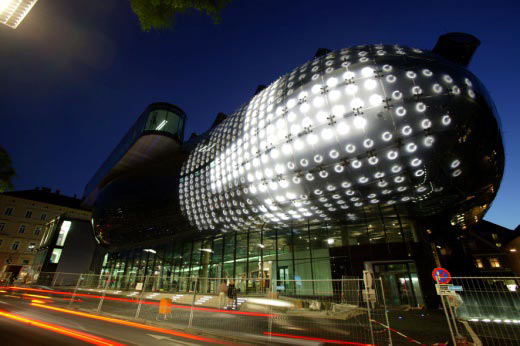
> Kunsthaus Graz, 2003
Architect: Peter Cook/Colin Fournier
Media façade: BIX / realities united
Photo: Harry Schiffer
Copyright 2007 - 2009 architeria.eu all rights reserved

