


Architecture exhibition. 16.05. - 30.06.2009. Berlin, Germany
Becoming Istanbul
.jpg "Architecture exhibition. 16.05. - 30.06.2009. Berlin, GermanyPosted: 27 April 2009") |
 |
.jpg "Architecture exhibition. 16.05. - 30.06.2009. Berlin, GermanyPosted: 27 April 2009") |
.jpg "Architecture exhibition. 16.05. - 30.06.2009. Berlin, GermanyPosted: 27 April 2009") |
.jpg "Architecture exhibition. 16.05. - 30.06.2009. Berlin, GermanyPosted: 27 April 2009") |
BECOMING ISTANBUL
16.05. - 30.06.2009 // OPENING: 15.05.2009
The DAZ presents two exhibitions on contemporary architecture as well as urban tendencies in Istanbul:
BECOMING ISTANBUL and 7 ARCHITECTS FROM 7 HILLS.
Exhibition: 16.05. until 30.06.2009 in the DAZ Taut Saal
Tue to Fri 12am - 7pm, Sat + Sun 2 - 7pm. Free entrance.
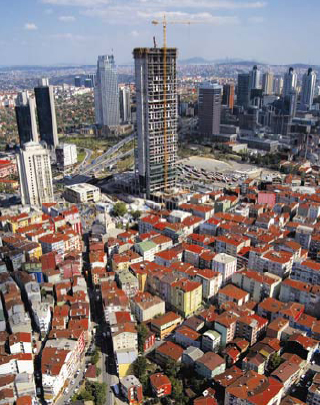
This exhibition does not describe Istanbul. Neither does it depict its history, its contemporary architectural environment which is gradually becoming more animated and productive, its complex social and economic structure or its becoming the focus of a popular culture of almost unparalleled richness. The exhibition is prepared with the purpose of visualizing Istanbul’s present state.
It consists of an interactive audiovisual database on contemporary Istanbul and a 16-minute complementary film titled ‘Mapping Istanbul’. Both attempts to look at Istanbul from multiple perspectives and free of all the familiar clichés. In doing this, the database, instead of producing and placing new stereotypes opposite those clichés, forms its own structure by instrumentalizing the clichés themselves. Media accessed through includes works by artists, architectural projects, videos, photographs, cartoons and essays. Users accessing these works produced in the last 10 years will have the chance to perceive the conditions and actors forming today’s Istanbul. There are 408 visual groups under the 80 sub-headings featured on the database. More than 7000 visuals were accumulated for the project. Mapping Istanbul constitutes an important source supporting the understanding of the city and the contemporary view the exhibition presented, at times completely overturning cliché judgments. A group of these maps features statistical information and the information is presented in comparative charts. Some other maps present relational cartographies.
Becoming Istanbul
Istanbul wasn’t always Istanbul. It has been Byzantium, Constantinopolis, in the mid-Byzantine period it was simply Polis, in the Ottoman period it was Kostantiniyye, İslambol and Dersaadet, and many other things; but it was never only Istanbul. Each toponymic change is a manifestation of radical differentiation in the urban space and a change in its social meaning. From the beginning of the 19th century on, the traditional cosmopolitanism, the plurality of which was formed from the sum of a series of fixed singularities, faced erosion. Although ideological engagements pointed in the opposite direction, the new cosmopolitanism of the city was slowly being constructed in place of the crumbling traditional cosmopolitanism. The city of fixed communities and statuses, where inflow and outflow was strictly controlled now set out to become a city shaped by the countless parameters of individualities, preferences, expressions, interests, groupings and separations. The city obtained the pluralism of a metropolis. It became an environment of “spontaneous freedom” where the oppression of recurrent totalitarian orientations has collided with the common pluralism of the metropolis. This characteristic of the city is becoming increasingly evident. The ironic aspect of the process is how this modern metropolis singularized its name although it opened itself up to the outward expression of pluralities. Today, for everyone, it is only Istanbul. During the phase of homogenization, which began in the 1920s and the phase of becoming plural, pluralist and cosmopolitan which began in the 1980s, the city forgot its countless old names. It generalized the name Istanbul, which was least political, least religious and least ethnical among the names in use.
It became Istanbul. It became a category where countless existences and meanings could be produced and placed under a single name, yet could never be filled. This is exactly what the title of the exhibition is pointing to. These countless existences and meanings are presented to the viewer and the reader in a plural milieu.
Book
The book produced along with the exhibition is a multi-authored bedside book which discusses the current changes that the city undergoes within 152 different items. With the intention of expressing "becoming Istanbul" from as many angles as possible, the authors were chosen from a wide range of professions: architects, musicians, city planners, chefs, activists, sociologists, economists, film critics, authors, museum curators, geographers, journalists, anthropologists, historians.
(BECOMING ISTANBUL An Encyclopedia.. Editors: Pelin Dervis, Bülent Tanju and Ugur Tanyeli.
paperback, 383 pages, black-and-white, ISBN 978 9944 731 06 5; 25 EUR)
BECOMING ISTANBUL is a project of Garanti Gallery originally realized for the German Architecture Museum (DAM Frankfurt) and is curated by Pelin Dervis, Bülent Tanju and Ugur Tanyeli. The exhibition at DAZ is supported by the Alfred Herrhausen Society, the international Forum of Deutsche Bank. It is under the patronage of the Mayor of Berlin and Senator for Urban Development, Ingeborg Junge-Reyer.
www.becomingistanbul.org
--------
Text: Deutsches Architektur Zentrum (DAZ)
Photography: Oguz Meric
Copyright 2007 - 2009 architeria.eu all rights reserved

